Why Evolution is True is a blog written by Jerry Coyne, centered on evolution and biology but also dealing with diverse topics like politics, culture, and cats.
The Academy of Natural Sciences of Philadelphia, the oldest natural history museum in the United States, is closing. Drexel University, with which the Academy became affiliated in 2011, announced on September 1 that the museum, located at 19th and the Parkway in Philadelphia, would close at the end of the month. The closing of the museum is a tragedy.
Two of the Academy’s acclaimed ornithologists, Rodolphe Meyer de Schaunsee and James Bond, in 1983.
The Academy was founded in 1812, and, in 1828, opened the museum at its first location, 12th and Sansom Streets; it opened at its current site in 1876. The Academy was the oldest surviving institution of its kind in America. As such, it was extremely influential in the development of American science, at a time when the scientific community, such as it was, was small and concentrated on the East Coast. Many 19th century scientists and naturalists were associated with the Academy in various capacities: Titian Peale, William Bartram, Alexander Wilson, John James Audubon, Spencer Fullerton Baird, John Cassin, Joseph Leidy, and Edward Drinker Cope, to name just a few. Charles Darwin was elected a corresponding member in 1860. Later Academy scientists include the original James Bond, the influential ecologist Ruth Patrick, and the co-describer of Tiktaalik, Ted Daeschler. The Academy sponsored expeditions all around the world, to places such as West Africa, Greenland, Mongolia, South America, and the West Indies. The American Medical Association (AMS; 1847) and the American Association for the Advancement of Science (AAAS; 1848) were both founded at the Academy.
The collections of the Academy are priceless. Because of its age, influence, and international connections, it has received, by gift, exchange, and purchase, parts of the collections of the Lewis and Clark expedition, the United States Exploring Expedition, Thomas Jefferson, Captain Cook, and John Gould (the British ornithologist who described Darwin’s Galapagos specimens). These collections of specimens, and the associated written records and library of the Academy, form the core of the Academy’s scientific (and history of science) enterprise. But, as James Smithson enunciated in his bequest that founded the Smithsonian Institution, such institutions are for the “increase and diffusion of knowledge ” (emphasis added).
The public facing side of the Academy– it’s museum, public programs, and educational outreach: the way it “diffuses” knowledge– are as integral to a great institution of natural history as are its scientists. Institutions vary in how much effort is devoted to the increase vs. the diffusion sides of their missions. Berkeley’s Museum of Vertebrate Zoology and Harvard’s Museum of Comparative Zoology lean towards “increase”, having an at most modest public face; Atlanta’s Fernbank Museum of Natural History is almost all “diffusion”; while the American Museum of Natural History in New York, Chicago’s Field Museum of Natural History, and the Smithsonian’s National Museum of Natural History excel at both. The Academy has always been among the latter– excelling at both, with an excellent public museum, as well as an active research program among its affiliated scientists.
I have several times visited the Academy to work in its collections and get information from its archives. My most recent visit was last summer, to the Bird division, where I was hosted by an active and welcoming community of senior scientists and graduate students. I regret that I did not have time to go see the exhibits– I could never, at the time, have fathomed that it would be my last chance to see them. I contemplated trying to get to Philadelphia during this final month, but the logistics and scheduling of such a trip during the first month of my semester were daunting. Had the closing been announced well ahead of time (say, the end of this year), rather than just one month ahead, I would have made it.
Drexel University promises in some vague way to preserve the “legacy” of the Academy, but past experience does not augur well. I am reminded of other university’s casual loss of their collections (Princeton’s, for example), while others had theirs saved only by an outside institution willing to take the specimens (Duke’s, for example). If the Academy’s building is closing, where will the collections go? (They are in the same building as the public exhibits.) And what will happen to the scientists, students, and other staff who are working there? The Academy has had its ups and downs over the years (as will any 200+ year old institution), and perhaps this is just a low spot from which public-spirited citizens, perhaps with the support of the city and the state, may be able to effect a rebound. But based on what I know now, I very much fear for my colleagues and the collections, not to mention the people of Philadelphia and the world who experienced the Academy’s “diffusion”.
Peck, R.M., and P.T. Stroud. 2012. A Glorious Enterprise: the Academy of Natural Sciences of Philadelphia and the Making of American Science. University of Pennsylvania Press, Philadelphia. A wonderful, well-illustrated, history of the Academy, celebrating its first 200 years, and intended to look forward to continuing glory. Now, it practically induces tears.
There will be no long Hili today, and probably not tomorrow, as I have to have my retina scrutinized (I think things are okay). Wish me luck, and bear with me.
Speaking of bears, we have a winner in Alaska’s Fat Bear Contest involving the ursines of Katmai National Park and Preserve. The champ: Backpack! The voting was close:
In the annual battle of the big bears, only one can be the winner. This year, 89 Backpack, was crowned the winner of Katmai National Park and Preserve’s Fat Bear Week.
The match came down to two single bears in a battle of the sexes. Backpack is an adult male who overcame an injury in 2007 and has what park staff describe as a “quiet toughness,” according to his bio on Explore.org, the media organization that helps host the event. And on the other side, representing the lady bears, was 910, an adult female whose mother, 409 Beadnose, was a previous Fat Bear Week champion.
It was a nail-biter: Backpack won by just over 5,000 votes, coming in with 103,344 over 910’s tally of 98,253 votes.
His name comes from childhood, when Backpack was often seen clinging to the back of his mother, Holly, while she swam across the river. (Holly was also a former Fat Bear Week champion.)
Earlier in the competition, Naomi Boak, a former communication specialist for the Katmai Conservancy who was a producer for the event for several years, said she was excited to see that 89 Backpack had earned a spot in the bracket at long last.
Backpack can be “elusive,” Boak said, making it hard to photograph him at the beginning and end of the season, which is necessary to enter a bear into the competition.
Boak was actually inspired to move to Alaska and work with the park when she watched Backpack from her New York City apartment in 2019 on the park’s livestream. She described him as her “gateway bear.”
Backpack, according to his bio, has fewer scars than might be expected on a male bear his age, because he is less aggressive than some of his peers.
“Unlike many large adult male bears, Backpack hasn’t shown much aggression toward his competitors,” his competition bio said. “He’ll stand up for himself when necessary, but he prefers to use a quiet strength to gain access to preferred fishing spots.”
There were four flydubai pilots aboard flight FZ1073 from Dubai to Tel Aviv on Wednesday when an alleged terror attack inside the cockpit sent the aircraft plunging thousands of feet and ultimately forced it to make an emergency landing in Saudi Arabia.Israeli officials said the co-pilot stabbed the captain and attempted to crash the aircraft before passengers and crew intervened. The flight transmitted the international 7500 code for unlawful interference, initially prompting fears of a hijacking, and Israeli fighter jets were scrambled as the crisis unfolded.Now, The Jerusalem Post can confirm why two other pilots happened to be aboard.The additional pilots had been placed on the flight because possible regional rerouting could extend the journey and push the original crew beyond permitted duty hours, a person familiar with the matter told the Post.
Their presence was unrelated to any advance security warning.
UAE investigators will now determine “whether the incident was linked to any terrorist activity or purpose, or involved prior planning or direction”, according to the UAE’s state news agency.
Abu Dhabi authorities have jurisdiction over the incident because the aircraft is registered in the UAE and flies under its flag, the statement said.
It comes after Israeli prime minister Benjamin Netanyahu has said it is “too early to say” who was behind the incident, as he hailed the actions of the flight’s captain.
Netanyahu blamed “fanaticism and hatred of an incalculable level” during a Fox News interview but said he has no confirmation yet of the motive for the attack. The attacker was arrested in Saudi Arabia.
A Tennessee woman convicted of murder survived two doses of lethal injection on Wednesday night before state officials suspended the execution and had her taken to a hospital for medical care, her lawyers said.
It was the second botched execution in the state this year.
The apparent failure came after dueling court rulings delayed the execution of the woman, Christa Pike, by about nine hours. The state had raced to go ahead with the execution before the day ended and to avoid having to reschedule.
In a pair of emergency legal filings, Ms. Pike’s lawyers said that while two syringes of pentobarbital, the lethal drug, had been administered, Ms. Pike had not lost consciousness. She still had a heartbeat, they said, and was audibly snoring.
It was not immediately clear what went wrong with the administration of the drugs, or what Ms. Pike’s medical condition was. In a statement late Wednesday, her lawyers said that she was at a nearby hospital but that they did not know her condition. Tennessee officials confirmed to a federal judge late Wednesday that Ms. Pike was receiving medical care.
“This event is the worst we’ve seen and unlike any other botched execution in the modern era,” said Robin Maher, the executive director of the Death Penalty Information Center. “There is no precedent.”
. . . It was the second time this year that Tennessee failed to administer the lethal drugs. In May, the state called off one of four planned executions because medical staff could not find a vein while administering a lethal drug.
Just one of several reasons I oppose the death penalty. It would have been more humane to shoot her, but I don’t think the state should kill anyone.
Meanwhile in Dobrzyn, fall is here in a big way:
Hili: And the apples are dropping again. Andrzej: It’s all because of that Newton.
In Polish:
Hili: I znów spadają jabłka.
Ja: To wszystko przez tego Newtona
Yes, the birds of Botany Pond have left, and by that I mean Miss Duck’s brood of four ducklings have taken wing and flew away to who knows where. The good news is that they all fledged, even though the “good” mother had abandoned the brood over a week beforehand,—when the young weren’t yet flying. The ducklings were zooming and even taking off a bit, so as long as I could keep them fed and safe, I knew they’d be okay. They clearly missed their mom, and weren’t eating as much, but they stuck together and, around September 14, three of the four were gone.
That left one duckling, whom I named Rupert. I don’t know if his wings weren’t yet fully developed, or he hadn’t learned to fly, but he stuck around looking forlorn and disconsolate, sitting on the bank of the channel. Here he is (the greenish hue at the base of his bill tells us he’s a male):
A sad duckling. He wouldn’t eat nor approach me, but mostly slept and rested on the bank of the channel.
But around September 19, Rupert was gone. Hooray!
Of course I don’t know where they are, but I hope they found some other ducks who will migrate south with them. As for the wanton Miss Duck, if she ever returns she’ll get a stern lecture about staying with her babies until they fledge.
Here she is, with her long periscope neck and gray coloration. If Miss Duck returns, I will know her for sure (I also have close-up photos of her bill).
The brood a few days before they started leaving. I call this iPhone photo “Golden Slumbers” after the Beatles song:
I call these “ducklings,” but they’re clearly adults: freshly minted mallards. Ba
This one, with an orange hue at the base of her bill, is a female (a “hen”; the males are called “drakes”).
We had a bit of duck drama/trauma a few days before they left. When I came to the pond, one of the females (below) was quacking continuously, and nobody would eat. I didn’t know what was going on. I asked someone on a nearby bench how long the duck had been quacking, and he told me that a Great Blue Heron (Ardea herodias) had been standing in the channel a while back.
That was it! The young female (only female mallards make the classic “quack”) was freaked out by the heron, as these birds can prey on young ducklings. While herons can’t take a duck of this size, these ducklings had clearly evolved to react to a potential predator of the young. When I took the video below the heron was gone, but while I was watchingfor an hour it flew over the pond twice, and each time the female quacked loudly, and all the other ducks froze in place. They stayed freaked out for several hours after I drove the heron away.
I learned later that the different calls have different meanings, and that this is a specific alarm call for predators (the differences among calls are small, and inaudible to most of us). The ducks know how to distinguish predators from harmless birds. When a heron or Cooper’s hawk flies overhead, even high up, they quack and freeze. If a crow, an airplane, or a goose flies over, there is no reaction. The marvels of natural selection!
Note that her wings are raised, too, something that the other ducklings did. I have no idea what that means.
How fast they grew! I’ve reversed the second picture below so you can see the difference between the brood at 1 day old and a little less than eight weeks old.
Note the bill color. The two ducks in front with the grayish-green bill bases are drakes, the two behind, with orangish bills, are hens. (The drakes develop their color and patterns, including the green heads, while overwintering.) We had a 50:50 split this year.
And a panorama of our summer home, Botany Pond:
We musn’t forget the other critters. We still have six turtles, since we lost one but two were added. Here’s one clambering painfully onto the rocks to get some sun. They are strong! (This took place during the heron-induced QuackFest, so you can hear some quacking in the background.)
And my squirrels, who grew quite tame. They clambered onto me to get nuts, and several even let me kiss them. They will be here this winter, as will the turtles, but we won’t see the latter as they’ll be dug into the pond bottom overwintering.
A smooch:
And so the latest Duck Year drew to a close. We had five broods, two of which wandered away after harassment by horny drakes, one of which we captured with a fence below their nest, but had to take to rehab when we couldn’t capture the mother, and one of which got mired in the algae, with three ducklings drowning, while I saved five and sent them to rehab. It was depressing, but then Miss Duck had a late brood in July and allowed us to bring a brood up from hatching to fledging. (The drakes had left by then.)
All the birds are leaving—the Great Duck Migration south is beginning in the Midwest—but perhaps one of them will return. I won’t recognize them unless Miss Duck is the one who comes back. And she faces a talking-to!
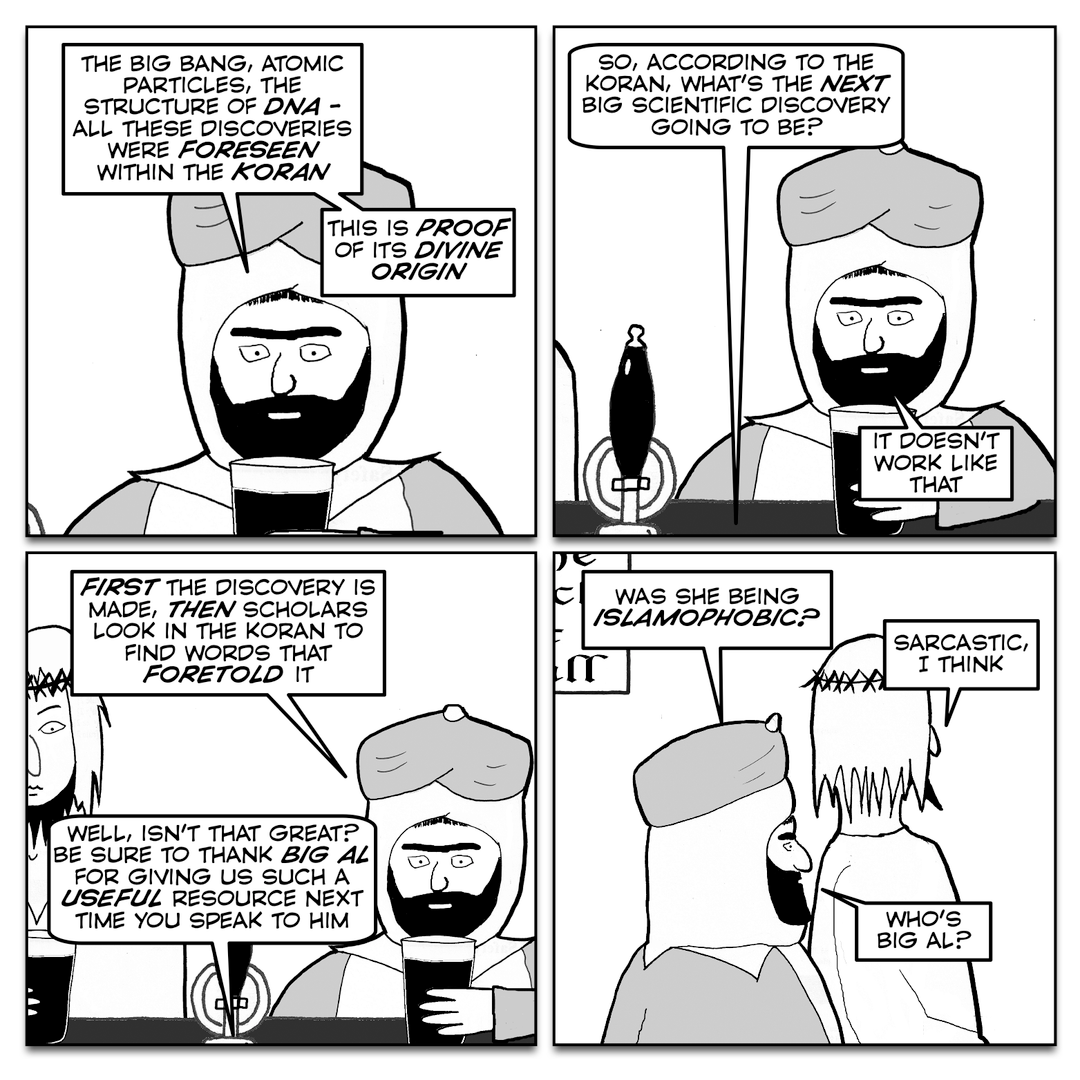
Today’s Jesus and Mo strip, called “bang2“, is an old one that I don’t remember, but it’s a good one. The term “retrodiction” is mine, though someone might have throught of it before I did.
The strip came with a note, and notice the new book on sale:
A resurrection from 2008 today, slightly edited. In other news, there’s a new J&M book out! It’s a best-of compilation, selected by me. 150 pages of J&M, without any crap ones!
In the strip below, of course you know who “Al” is, right?
Welcome to Wednesday, September 30, 2026—the last day of the month and also a Hump Day (“Lillördag” in Swedish). It’s also International Goose Day, and here’s a goose and two goslings I photographed on Svalbard last year. Do you know the species?
*Breaking news, ripped from the headlines (h/t Jay): there was a foiled hijacking of a plane bound for Israel. Over at It’s Noon in Israel, Amit Segal described it as “Miracle on flight FZ1073.”
It’s Wednesday, September 30, and for the first time in over 20 years, someone has tried to hijack a plane bound for Israel. Miraculously, the attacker, an Omani pilot, was overpowered before he could complete his mission.
The entire region held its breath as the morning Flydubai flight from Dubai to Tel Aviv sent an emergency signal, flashed the hijack code and appeared to veer off course over Saudi airspace. The region then exhaled, almost with a chuckle, when early reports blamed a scuffle between the two pilots. That laughter quickly died as security assessments and passenger testimony revealed that the co-pilot had repeatedly stabbed the captain. The terrorist then seized the controls and pointed the plane toward the ground, dropping almost 20,000 feet in just over a minute, until several crew members and passengers forced their way through the cockpit door and subdued him. Many were injured in the process. The plane made an emergency landing in Tabuk, in northwestern Saudi Arabia, where the passengers are now waiting for Israel to bring them home.
The assailant’s specific motive and affiliation are still unconfirmed, but Israel is treating the incident as terrorism.
It’s also reported in the NYT, which describes it as a “clash in the cockpit”. Jay Tanzman sent me this email:
I was up all night watching this unfold in real time on X. Copilot on a FlyDubai flight from Dubai to Tel Aviv repeatedly stabbed the pilot and took over the flight, diving the plane toward the ground in an apparent 9/11-style hijacking. Israeli passengers broke into the cockpit and overpowered and subdued the copilot. Two pilots, who were on board as passengers, then took over the flight and landed the plane, which had suffered significant tail damage in the high-speed dive, at a Saudi Arabian airport, while an Israeli doctor tended to the critically injured pilot.
The first Russian jet-powered drone slammed into the warehouse about 11 a.m. on a Saturday in August. The fire burned so hot that employees could not extinguish it. Within minutes, the second drone hit the building, and everyone ran for the shelter. The fire burned for almost a week. By then, almost everything inside was gone.
This was no weapons depot, no drone manufacturer, no cog in the war machine. Instead, the warehouse targeted by the drones belonged to Ranok Publishing, one of the largest children’s book publishers in Ukraine. The company, based in the northeastern city of Kharkiv, was attacked during one of its busiest times, when it was preparing textbooks for the new school year.
“It’s such a disaster,” said Viktor Kruglov, the publishing house’s chief executive, who was working at the warehouse with about 50 employees — all of whom escaped injury — when it was hit.
“Russia thinks that books are more dangerous for them than military equipment,” he said. “They deliberately damage, erase, extinguish everything which is connected with Ukrainian culture.”
All eight million books inside the warehouse were destroyed, including 620,000 textbooks. Though the strike was the worst attack on books this summer, it was far from the only one. All told, Russian shelling has destroyed as many as 15 million new books in recent months, almost half of Ukraine’s annual production, said Artem Bidenko, chief executive of the Ukrainian Publishing Association.
Note that aiming at civilian facilities with no military import is a war crime. Ukraine has done it too, but not to the extent that Russia has. And since Ukraine gave Russia no provocation to start a war, one might call this a Ukrainian genocide.
*In an ideal world this shouldn’t need to be written, but we don’t live in that world. And so we have a piece by Eli Lake at the Free Press called “The moral illiteracy of Hasan Piker.” (Remember that he’s campaigned with Abdeul El-Sayed, AOC, and Ilhan Omar (the latter two to mobilize voters).
Is America really worse than al-Qaeda? It’s hard to imagine that any serious person could answer yes. But that is the sincere view of Hasan Piker, the wildly popular left-wing Twitch streamer who has been elevated by many Democrats and progressives during the 2026 midterm elections as a way to attract Gen Z men.
“Pound for pound, as far as the number of deaths, yes,” said Piker in response to Axios reporter Alex Thompson in an interview clip released Thursday. Piker went on to claim that America sows terror all over the world. For example, during the opening strikes of the Iran war in February, a U.S.-made Tomahawk missile hit an Iranian girls’ school in Minab, collapsing a main building. “If you’re killing 140 schoolgirls, that is an act of terror,” Piker added in the Axios interview.
This is moral blindness: the death of the schoolgirls was an accident based on erroneous information; it was not meant to happen. But wait: there’s more.
This is the kind of sophistry that passes for sophistication in a streamer’s comment section. In national politics though, such claims should be self-discrediting. Al-Qaeda deliberately kills civilians to advance its warped ideology. America also kills civilians, but not by design, and usually only in wars being fought to advance the national interest.
The strike on the Iranian girls’ school in Minab was a tragedy, but it was not because U.S. war planners wanted to kill civilians. Rather, it was because the targeting data was out of date. The missiles missed their intended target, U.S. officials have said. An investigation by the U.S. military has not been published. In contrast, when al-Qaeda operatives hijacked airplanes on September 11, 2001, and turned them into guided missiles aimed directly at the World Trade Center and the Pentagon, the intention was to kill as many innocents as possible.
. . . Piker still insists that the forces of jihad are superior to America and her allies. Piker has praised the so-called resistance operations of the Houthis and Hezbollah. This week on the MS NOW show Clock It with Symone & Eugene, when Piker was asked about his previous statement that “Hamas is a thousand times better than Israel,” he responded that what he said was “intentionally provocative” but also “not untrue.”
. . .The problem is that many Americans do not remember what it was like when we were under attack on 9/11. For the 35-year-old Piker and those who see the world as he does, the legacy of 9/11 is the spread of Islamophobia, the curtailing of civil liberties, and pointless wars in the Muslim world. Perhaps this ignorance was inevitable, but Democrats do not have to indulge it.
Sadly, that is exactly what many Democrats—and the left more broadly—have chosen to do when it comes to Piker. For a while at least, Piker was not challenged and condemned. He was feted. In April, The New York Times featured him on a podcast to discuss the virtues of shoplifting. The College Democrats of America invited Piker to speak at its annual convention in July, where he delivered a fiery speech dressed in the style of the late Chinese dictator Mao Zedong. Piker also was a crucial surrogate in Abdul El-Sayed’s successful primary campaign to be the Democratic nominee to represent Michigan in the Senate.
Piker’s stock has dropped since then, but he still has millions of followers and Grok estimates that this American-hating chowderhead makes $2-4 million per year.
Among the political and public-policy figures signing the letter are former UK Prime Minister Boris Johnson; former Canadian Minister of Justice and Attorney General Irwin Cotler; former UK Cabinet minister Nadhim Zahawi; former U.S. Secretary of Veterans Affairs Robert Wilkie; former senior U.S. diplomat Elliott Abrams; and former White House Council of Economic Advisers Chair Jason Furman. They are joined by prominent scholars, historians and intellectuals, including Harvard professor Steven Pinker; historian BennyMorris; historian Sir Niall Ferguson; Ambassador Deborah Lipstadt, University Distinguished Professor at Emory University and former U.S. Special Envoy to Monitor and Combat Antisemitism; former Yad Vashem Chief Historian Dina Porat; Yossi Klein Halevi, Author and Senior fellow at the Shalom Hartman Institute; Brandeis University Professor Emeritus Jonathan D. Sarna; historian Simon Sebag Montefiore; historians Jeffrey Herf and Norman Goda; UCLA professor Judea Pearl; author Ayaan Hirsi Ali; Professor of History and Judaic Studies at Binghamton University Jonathan Karp; and urban-warfare expert John Spencer.
I signed it too, thugh I ain’t no “leader”. From the Jerusalem Post:
“There is a vigorous debate within the Jewish community over aspects of how this war was fought, and that is a sign of moral health. So is our pain over every innocent life lost. But we must unite in repudiating the lie of genocide,” the letter states.
It goes on to address the “unprecedented combat conditions” in Gaza, including Hamas’s use of “hundreds of kilometers of tunnels, thousands of boobytrapped homes [and] the conflating of combatants with ‘journalists’ and ‘human rights workers.’”
It also addresses the civilian-to-combatant casualty ratio, which it says is “considered low for asymmetrical urban warfare.”
Taking the Gaza Health Ministry’s current death toll, which does not distinguish between civilians and combatants, alongside INSS’s May estimate of more than 23,000 terrorists killed, the implied civilian-to-combatant ratio would be roughly 2:1.
The letter also cites “the absence of mass starvation despite repeated claims of imminent catastrophe” and “the warnings given to civilians before attack,” and asserts that “All these factors were erased in the eagerness to indict Israel for genocide.”
Meanwhile, the letter argues that Israel went to war after October 7 to break what it calls an “Iranian-led siege of terror enclaves” on its borders, while noting that anti-Zionists were already leveling accusations of genocide against Israel the following day.
“The bitter irony is that Israel, home to half the world’s Jews, is the only country to face a sustained war of attempted genocide – from its inception in 1948 until today,” the letter states.
And although I signed the letter, I’m under no illustion that it will accomplish much—or anything. The “genocide” mongers have simply changed the definition of a well-established term to suit their purposes, and they’re not going to admit that they’re wrong. All one can do is point out that many, many things that Israel has done in the Gaza war are apparently aimed not at extirpating civilians, but helping them. I have seen no responses when those things (warning civilians of strikes, creating “safe zones”, sending polio vaccines) are mentioned.
*This is what AI makes possible. The WaPo reports that a University of Chicago statistician “published” (I’m not sure where) over 200 coauthored papers and 14 books in a single year. An online site where his papers were placed, the Social Science Research Network, has removed 257 of them.
Many academic researchers publish only a handful of papers each year, seeking scientific discoveries or solutions to everyday problems facing businesses and government agencies. Some especially busy professors might publish a dozen or more studies a year.
The University of Chicago statistician has authored or co-authored more than 200 papers and as many as 14 books released this year, unleashing speculation on the internet about whether he used artificial intelligence to inflate his production without disclosing the assistance.
. . .The online platform where Polson posted his papers said itremoved 257 of his works over the past month after his surge in releases. Critics have not accused Polson of fraud, but have raised questions about whether Polson properly disclosed his use of AI and whether it’s even possible to produce that many high-quality papers in so short a span.
Polson acknowledged in an email to The Post that he used AI to help produce the work, but did not say whether he disclosed the use of AI in any of the papers he published.
Most of Polson’s papers focus on advanced statistics and mathematics, though some touch on topics of broader interest. Those include efforts to understand the financial pressures that could lead to cuts in Social Security and other benefit programs, why players excel at certain strategic games like chess, and how TikTok serves up certain videos that engage viewers without informing them.
“Two hundred-plus papers in nine months is both unheard of and unbelievable,” he said.
The questions about the papers were so significant that SSRN, the platform Polson used to share the research papers, took down the articles over the past month and froze the accounts used to post the works.
Polson suggested the complaints stemmed from jealousy.
“Clearly AI makes a productive researcher far more productive,” he wrote in an email to The Post.
The controversy highlights a growing concern in academia about whether some researchers could rely too heavily on AI to churn out a wave of papers that overwhelms journals charged with vetting the work.
Well, overwhelming journals with papers is not the problem: the problem is whether producing so many papers involves producing a number of trivial results that shouldn’t be published because they’re trivial or don’t really advance knowledge.
College professors and administrators have been busting students for cheating with artificial intelligence for several years. Now, the professors and administrators are getting in trouble, too.
Dartmouth College last week announced it was investigating its provost, Santiago Schnell, after the college’s student-run newspaper found that some of his published writing appeared written by A.I.
Dr. Schnell, a mathematical biologist, is perhaps the most prominent in a growing cast of college professors and administrators who have been accused of using A.I. in a way that crosses ethical lines. There have been instances of opinion articles, research papers and even campuswide messages to students showing traces of A.I. influence. He issued a statement apologizing.
Administrators wring their hands, and sometime issue punishments, when students outsource writing assignments to a robot to save time or avoid the hard work of thinking.
Some students are calling out the examples of faculty doing the same thing as hypocritical.
“It just goes against all the values of our institution and the concept of academia,” Eli Moyse, a Dartmouth senior, said in an interview.
A working group at George Washington University said in a report in August that many students reported “doubts that faculty themselves are using A.I. ethically and transparently.”
And at Brown University, a survey found that close to two-thirds of undergraduate students who responded had some worries about faculty members relying on A.I. to develop course lectures and other content.
At Dartmouth, Dr. Schnell’s A.I. use in public writing came up in an investigation in August by the news site Semafor about A.I.-created writing appearing in the opinion pages of major publications. That investigation said an Aug. 9 commentary by Dr. Schnell in The Washington Post was written by A.I. The opinion article was about A.I. cheating in school.
Here’s the Pangram analysis of Schell’s WaPo commentary: 78% written (not tweaked) by AI:
(The Semafor investigation also found indications of A.I. writing in New York Times opinion articles.)
The follow-up investigation in September by the student publication, The Dartmouth, found extensive A.I. use in Dr. Schnell’s published work this year.
Dr. Schnell told The Dartmouth in a statement that he used A.I. “for language refinement, copyediting, improving clarity and organization and making writing processes more efficient.” The newspaper then ran Dr. Schnell’s statement on his A.I. use through an A.I. detector, which flagged the statement itself as apparently written by A.I.
Dr. Schnell did not respond to a request for comment.
Crikey, if you’ve gone all the way up to Provost, or a tenured professorship, you damn well better be able to write! Tweaking may be okay, but Pangram looks for AI-generated content, not just writing tweaked by AI. The Washington Post should annotate or even remove Schnell’s article, for 4/5 of it wasn’t written by him.
Meanwhile in Dobrzyn, it’s a big day tomorrow!
Hili: Tomorrow is the release of your book. Andrzej: Yes, it’s going to be a busy day.
In Polish:
Hili: Jutro premiera twojej książki.
Ja: Tak, to będzie pracowity dzień.
As of yet the book is only in Polish, but you can see its website in English here (the title in English is The Blue Stone of Sisyphus.And I’m honored to have taken the cover picture:
I want to thank Hannah Neumann for her principled decision to reject a meeting with officials of the Islamic Republic.
Member of the European Parliament Chair of the Delegation for Relations with the People of Iran understood what tyrants never do: the Islamic Republic is not… https://t.co/X1IvEhiMJq
This scene is the epitome of ignorance. Not only in Gaza or Ramallah would this protester be lynched, but also in any Arab or Muslim city.
Do these useful idiots have any Muslim friends? Do they have any Palestinian friends? Do they know anything about the cause they are… pic.twitter.com/Koel1sQadd
From Luana. You can read the new “definitions” here (section 2):
Today, the Trump Administration is formally putting into regulation what the law has said all along: Title IX’s protections are based on SEX, not “gender identity.” pic.twitter.com/N0K36S90Dy
And one from Doc Cobb, which he sent in an email titled, “The audacity of these people.” And he’s right.
New HHS Hall of Heroes: John Snow, Ignaz Semmelweis, Joseph Lister, Alice Stewart, Herbert Needleman, Frances Kelsey, Rachel Carson, Jay Bhattacharya bit.ly/4hg6Rn0
In my view, her best song was “And When I Die“. Here it is from her first album, and remember she’s nineteen when she’s singing here. But she wrote the song when she was just seventeen. Imagine a teenager producing such a complex and sophisticated classic!
Hallelujah, we have a contributor! (Please send in your wildlife photos if you want this feature to continue.) The contributor is Jan Malik, who has birds and mammals from Poland. Jan’s captions are indented, and you can enlarge the photos by clicking on them.
In this batch, I have included pictures of birds and mammals from the Tatra Mountains that I had a chance to photograph during my hikes over the last couple of years. They consist of both lowland generalists that have penetrated into the boreal forest zone and alpine specialists.
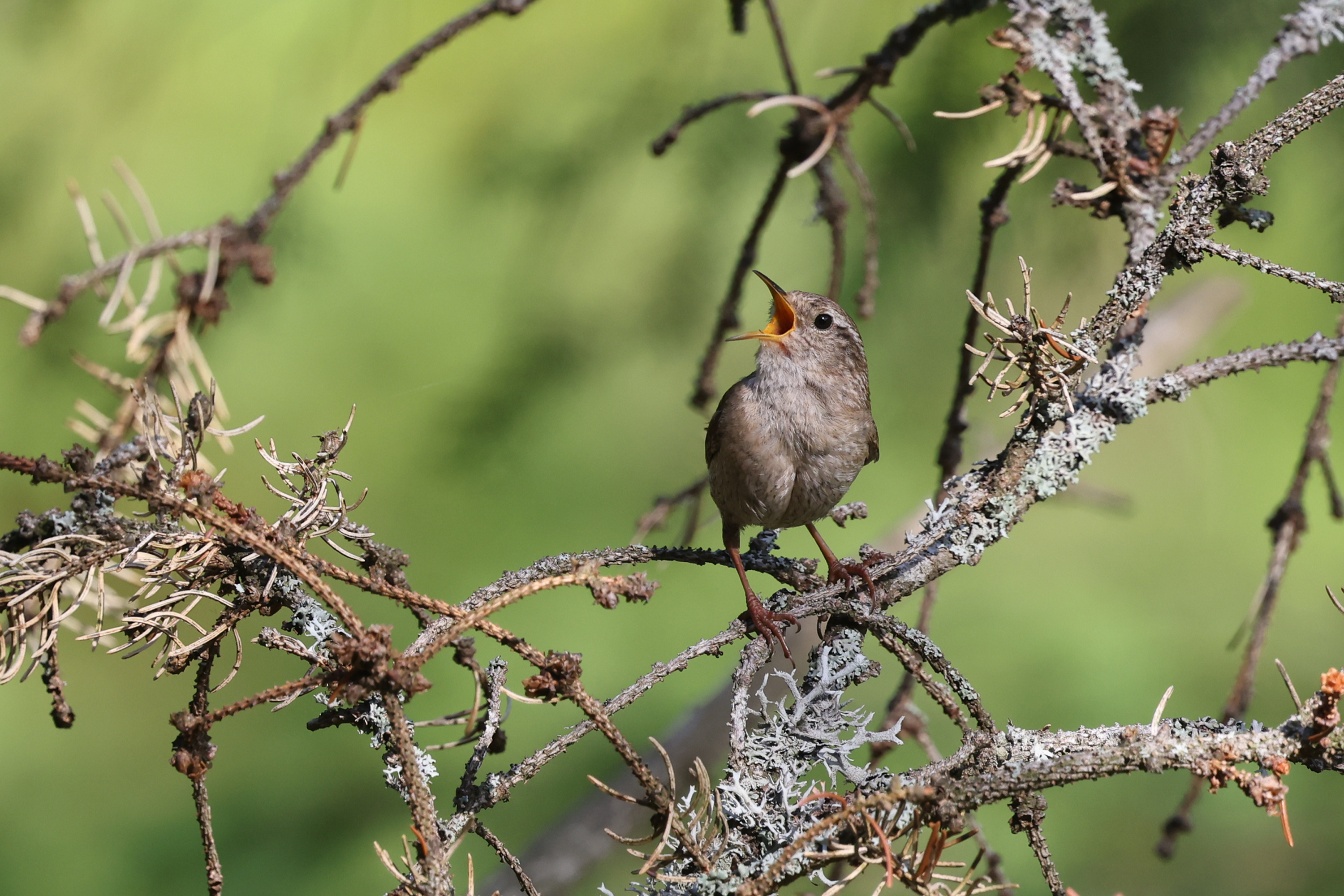
The Eurasian wren (Troglodytes troglodytes) is the only representative of the wren family in Europe. It was given the name “Troglodytes” (“cave-dwelling”) because it often searches for arthropods in rocky nooks and crannies; this behavior allows it to feed even in snowy conditions. Like the American marsh wren, males construct several nests, possibly both as a display of fitness for the female and as a decoy against predation:
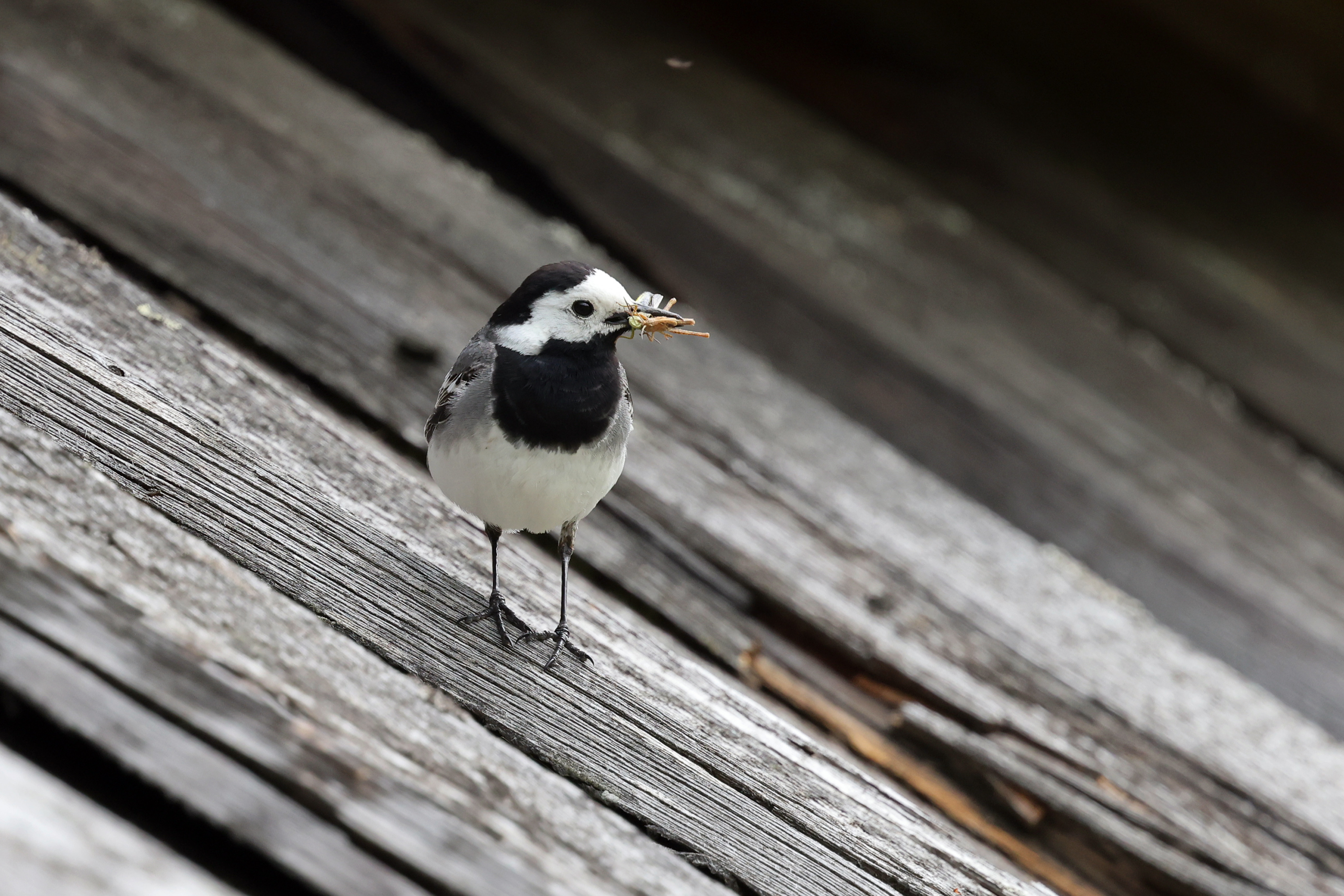
The White wagtail (Motacilla alba) avoids dense forests but can penetrate from the lowlands into mountain valleys with meadows left from the earlier pastoral economy of the region or near ski slopes. This bird (just like the wren above, females and males are identical) was well aware of my presence and refrained from rushing to its nest so as not to betray its location:
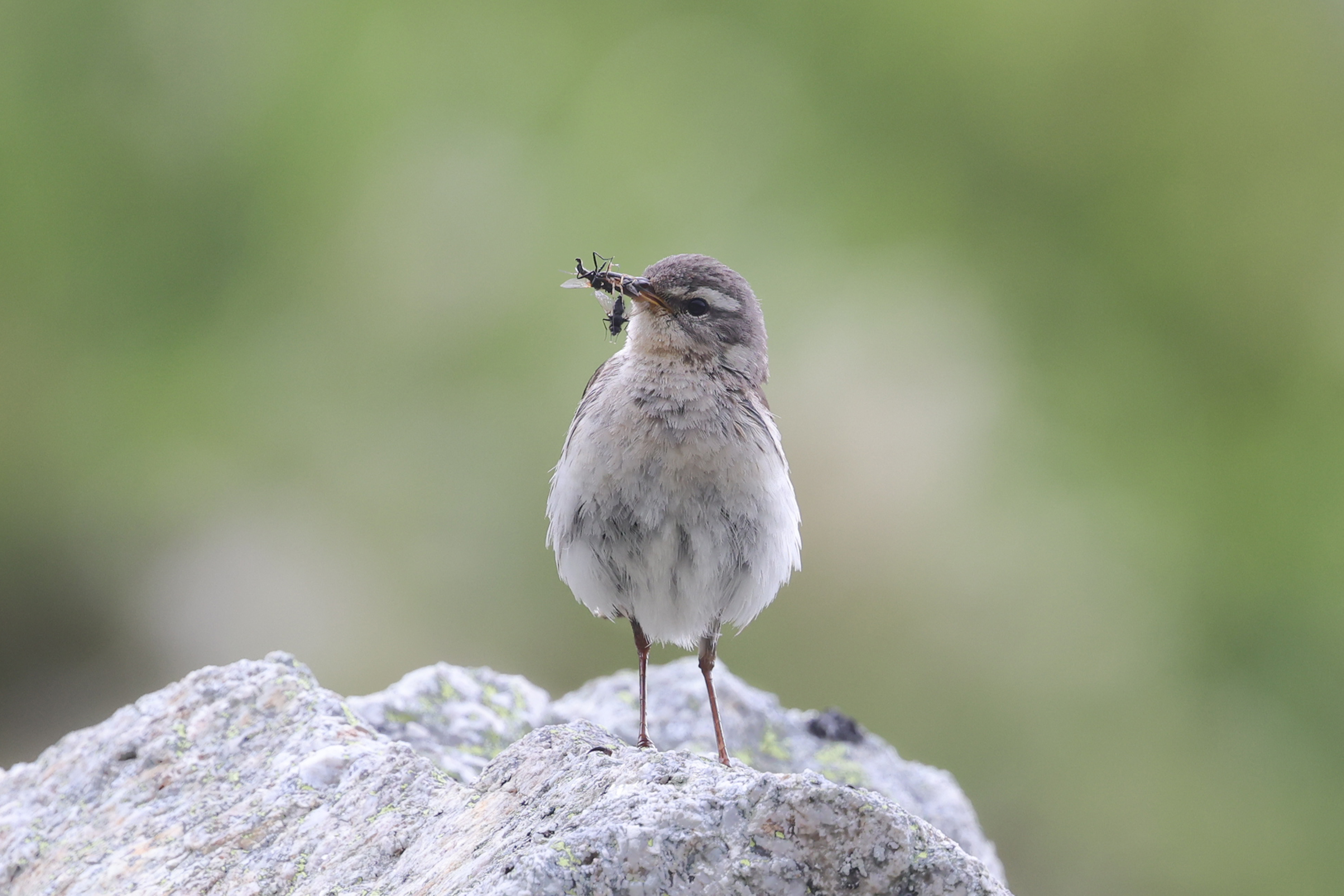
Possibly a Water pipit (Anthus spinoletta), which is an altitudinal migrant—in summer it nests in the alpine zone, but in winter it relocates to wetlands or riverbanks. Its nest is well hidden in a rock crevice or in a tussock of grass:
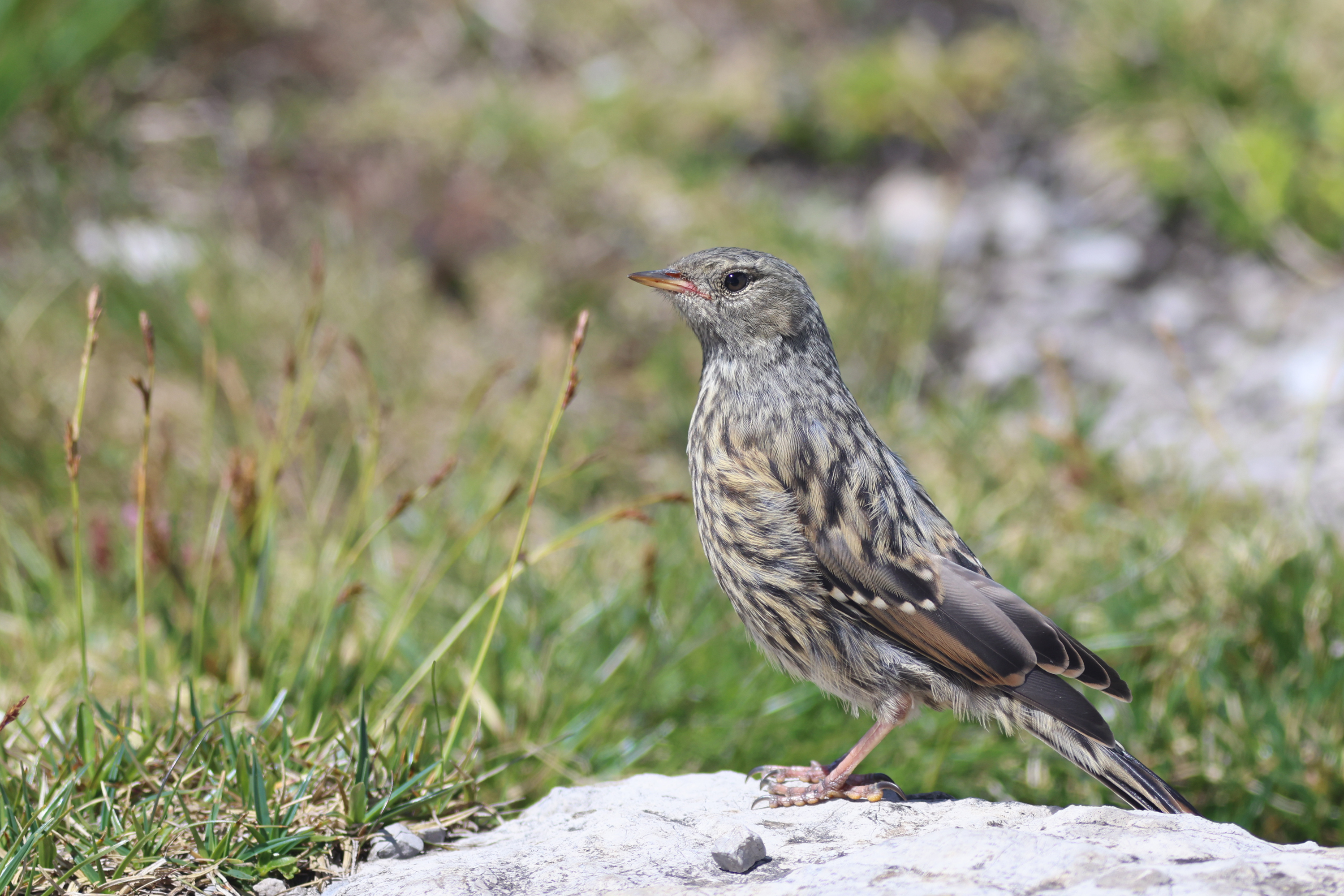
The Alpine accentor (Prunella collaris) is a mountain specialist, staying in the alpine zone all year round except during very bad weather, when it can descend into lower valleys. A thick layer of down protects it against the cold.
It easily becomes habituated to people and is often seen on the highest summits, where it fearlessly scavenges for scraps of food among hikers:
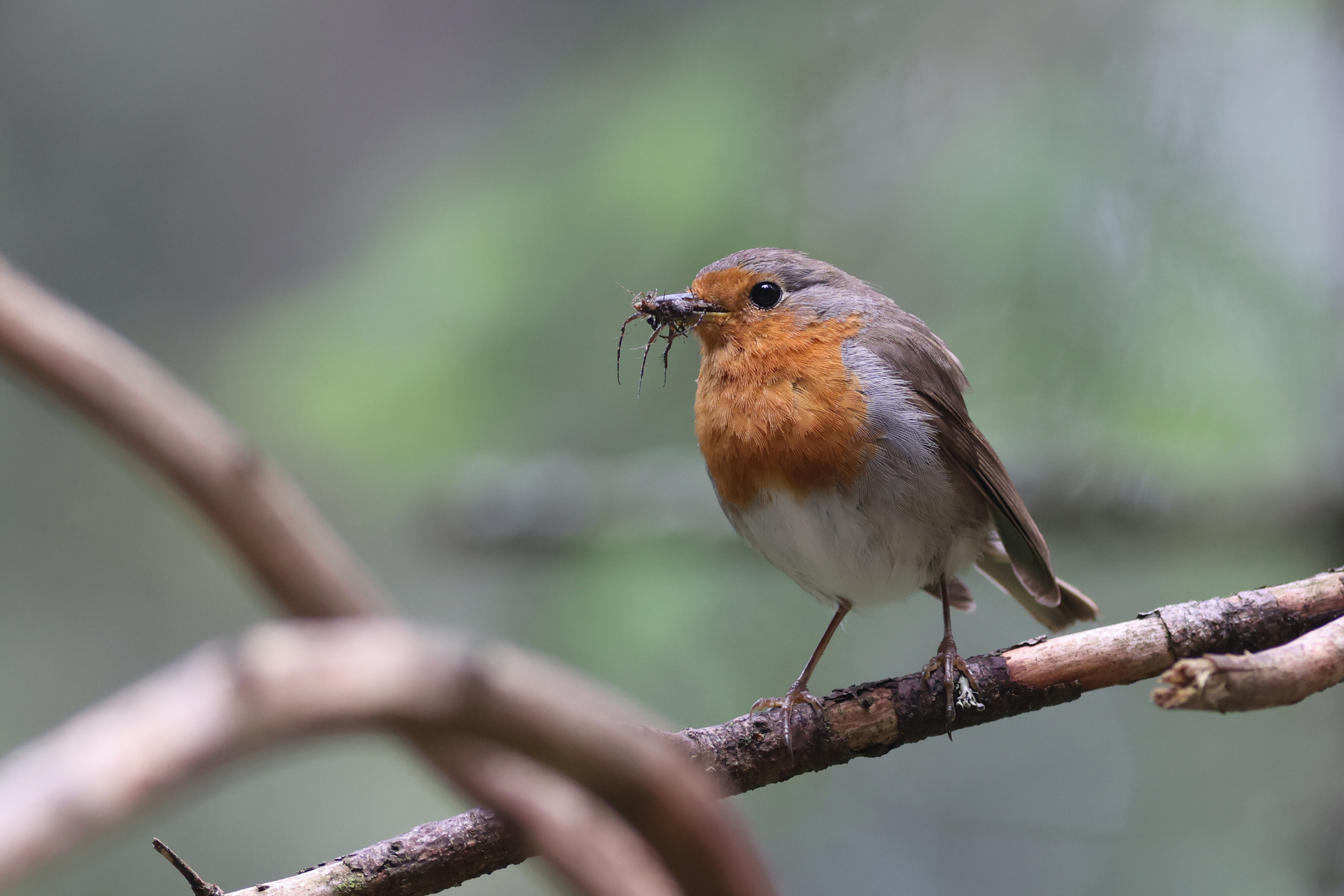
This is a European robin (Erithacus rubecula), which, like the other birds mentioned above, is a species where females and males look alike. It is a generalist with a range that just penetrates the boreal montane forest. I saw them follow cattle or humans to catch insects fleeing from the disturbed ground. They look cute but are extremely territorial, and fights between two competitors can be deadly:
Not too many pixels on this Dunnock (Prunella modularis), which, unlike its cousin the Alpine accentor, is not limited to the mountains and does not go above the krummholz zone. It has a complex mating system consisting of a mix of polyandry and a “mating cooperative,” where a couple of males maintain a territory containing a couple of females:
The European goldfinch (Carduelis carduelis). I found this male (with a slightly larger red mask than the otherwise similar female) by first noticing a stream of thistle seeds drifting in the wind. This species stays in warmer lowlands with an abundant presence of thistles, which are used for both food and nesting material. In a fashion similar to the famous Galapagos finches, this species evolved a high-precision bill to extract nutritious seeds defended by thorns:
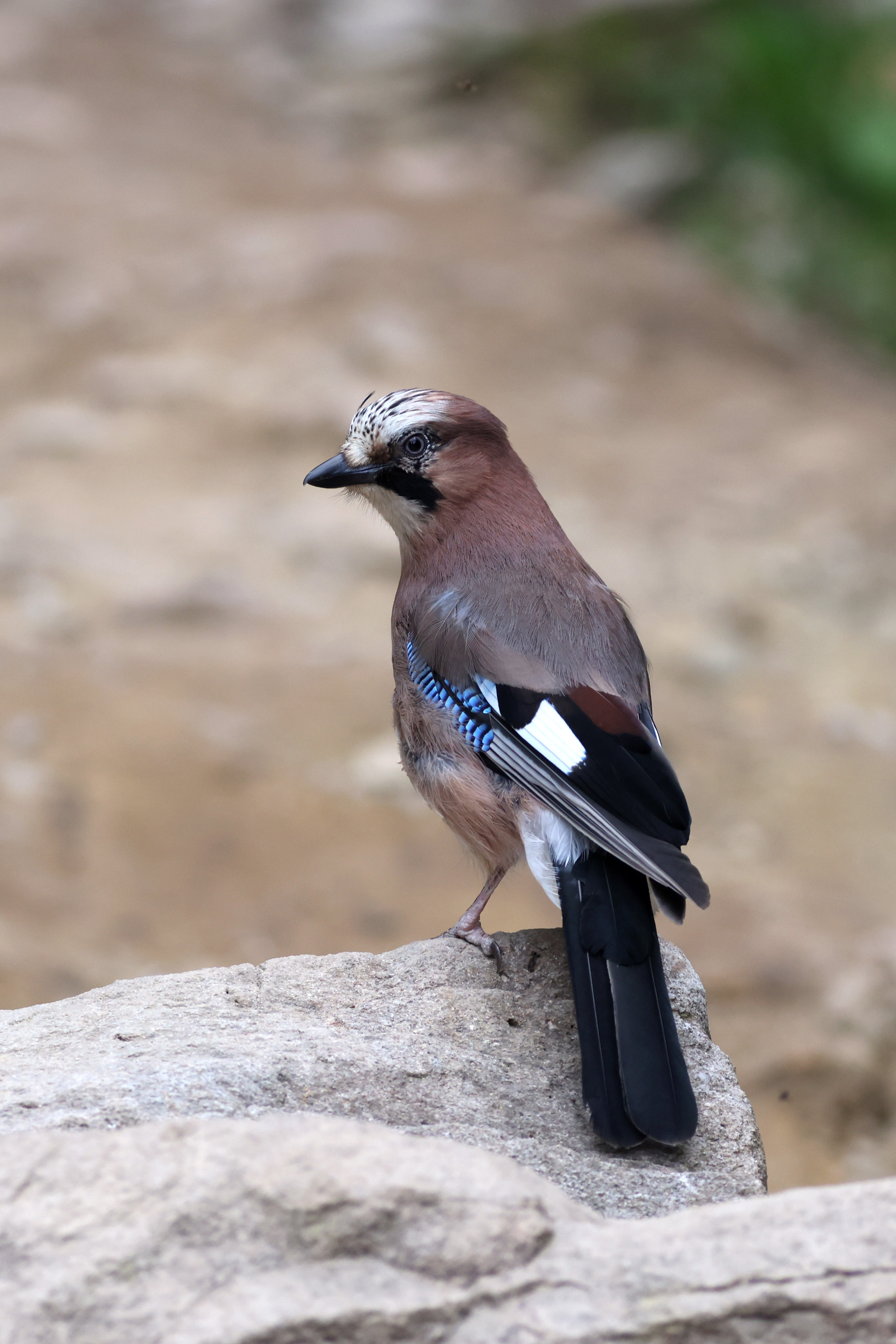
This Eurasian jay (Garrulus glandarius) is an edge-habitat dweller, hiding and nesting in lowland forests and entering only the lower boreal forest in the mountains. As a corvid, it is quite smart for a bird; however, with the many acorn and beech nut caches it makes for the winter, it always forgets a portion of them and thus contributes to forest growth. This one was patrolling a popular trail, looking for crumbs:
For the next two four-legged species, this is what their habitat looks like—an alpine tundra just below the barren high alpine zone:
Passing through it, finding a herd of Tatra chamois (Rupicapra rupicapra tatrica) is quite likely. The shaggy appearance of this individual is due to post-winter molting. Despite being commonly seen in the Tatras, it is an endangered subspecies; their numbers plummeted at the turn of the millennium to fewer than 200 individuals and have since increased to over 1,000 thanks to strict limits on tourist traffic in sensitive areas:
This mountain goat-antelope has close cousins in the Alps and parts of the Carpathian Mountains, but the Tatra population is completely cut off from them, since they are obligate mountain dwellers and do not tolerate dense forests or plains. The Tatra population has been isolated since the end of the Pleistocene, for at least 15,000 years. Over that period, the Tatra chamois evolved a special trait: unlike the Alpine chamois, it stays above the forest zone throughout the year. In the Ice Age, they populated the vast, ice-free montane tundra in that part of Europe (https://www.researchgate.net/figure/Maps-showing-the-geographic-distribution-of-the-extant-subspecies-of-the-genus-Rupicapra_fig1_336957033):
The Tatra marmot (Marmota marmota latirostris) is another Ice Age holdover that became marooned on a high-altitude “island” as the climate warmed after the Pleistocene. It has had no contact with other groups of alpine marmots for at least 10,000 years. This site (https://www.inaturalist.org/taxa/46082-Marmota-marmota#map-tab) shows how fragmented the marmot habitat is:
The marmot also stays above the forest zone all year round. Since summers in the Tatras last only about 5 months, all of the marmot’s active life must occur within that short period. In the winter, it hibernates in a deep burrow and emerges emaciated in the spring, when it must nearly double its body weight to prepare for the next winter and breeding season:
And as a reminder of how crowded the Tatras can get, here is a Red deer hind (Cervus elaphus) that was trotting along a trail and forced me to step aside to let her pass. As in many other national parks, animals in the Tatra Mountains become habituated to people. Red deer are vertical migrants—feeding on montane meadows and in boreal forests in the summer, but retreating to lowland pastures and forest edges in the winter:
There will be no long Hili post this morning (though of course Hili’s dialogue is below) due to medical exigencies, i.e., visits to eye doctor (I’m ok).
But here’s one issue for discussion, taken from a new op-ed in the NYT. Joe Cruz, head of the philosophy department at Williams College, where Luana works, has a piece called “What if writing isn’t central to thinking?” (article archived here). If his thesis is true, it will give students license to use AI for essays and exams, which in fact Cruz allows. He has a workaround for that, but it’s not a good one.
His thesis:
Most college professors I know believe that students learn to think — critically, creatively, reflectively, tenaciously — only by writing. At Williams College, where I am a professor, writing skills are among the very few general education requirements.
It’s no surprise, then, that universities see artificial intelligence as an existential threat, and have launched an arms race of countermeasures: more proctored essay exams; test-taking rooms shielded from the internet; requirements that essays be composed on platforms that track all edits, so the word-for-word genealogy can be verified. I’ve heard professors rejoicing when they see typos or grammatical errors in an essay, as if they proved that a student wrote it without any help from A.I.
But what if we are mistaken in treating writing as the highest cultivation of thought? The evidence that supports this belief is thin at best. Writing can be useful cognitive scaffolding for memory and self-regulated learning, but the notion that it is the best process for developing thinking skills is a fairly recent idea, traceable to the 1970s writing-across-the-curriculum movement.
His lack of evidence is merely a lack of relevant research. But Cruz finds support from none other than Socrates!
In Plato’s “Phaedrus,” Socrates offers a startling criticism of writing. Written words, he claims, are not the true children of knowledge, because writing cannot speak, answer questions or come to its own defense. [JAC: OF COURSE it can if the response is also in writing.] Only through conversation among minds, he suggests, does reason yield real insight. For the past two millenniums, this appraisal has seemed like a failure to appreciate the power of writing. But perhaps Socrates was right, and we think best by speaking, answering and defending of our ideas.
The problem here is that you can have back-and-forth discourses in writing (here’s one I had with Adam Gopnik about whether there’s truth in art.) And those are permanent, forcing you to think carefully, because once something’s published, it’s usually permanent.
But the essay gets worse:
I don’t rely on prepared scripts when I teach, and few of the teachers I most admire do. Instead, I engage my seminar students through messy, searching conversation, responding to their presence in the classroom to gauge whether we’re understanding one another. I want to make new connections in the immediacy of our back-and-forth. I want to recall a thread from two class meetings ago spontaneously and weave it into my improvised lecture while snapping into new ways of thinking about it in the moment.’
Here Cruz is talking about seminar classes—small discussion group with a back-and-forth in a small group. You can have those in philosophy, but not when teaching basic physics, chemistry, or biology. This doesn’t work with a larger class, of course. He does admit some use for essays, though how will he ensure that the essays aren’t written by AI?:
Writing assignments serve practical needs of colleges and universities. When we receive a batch of 10-page essays, we can take them home, read a few, put them aside and grade the rest when the opportunity arises. If our minds wander, we can reread the prose before us. If we need to justify a grade, we can cite the record. Writing is a portable, compact trace of mind that is more manageable in a bureaucracy than is a conversation. But none of these conveniences is about developing the best thought.
And here’s his solution: we must “think aloud together”!
Last semester I permitted my students to use A.I. tools on their final essays in accordance with specific guidelines. Each then had a 45-minute oral exam in which I could audit their understanding of their claims and push them further in their analyses. I was reassured by the results. In no case did I suspect that an A.I. had written a student’s paper in the substantive, objectionable way that we are all concerned about. The students were all too sharp on the ideas, too deft in reconfiguring their thoughts and extending them dynamically. Moreover, at least half of the class was more agile, more reflective and clearer during oral exams than they were in their papers.
I believe colleges can permit the use of A.I. writing tools without undermining the next generation of thinkers. But to get there, we need to embrace a different image of a university education — one in which ideas are expressed in real time and analytical thought unfolds as a debate or an oral defense or a group discussion. It will take courage to demand that students demonstrate active, participatory mastery of ideas. And it will take courage on their part to abandon the safe recursion of revision and narrative refinement. To be sure, there will be challenges of scale, and not every kind of institution will be able to adapt. The benefits, however, may be enormous.
Well, if all learning occurred through Socratic dialogue between professors and students, that’s fine. But as we all know, that’s not the way it works. There are many courses with too many students How do you have a 45-minute oral exam if you have 600 students? And Cruz seems too credulous to me: “In no case did I suspect that an A.I. had written a student’s paper in the substantive, objectionable way that we are all concerned about. The students were all too sharp on the ideas, too deft in reconfiguring their thoughts and extending them dynamically.” I call bullshit on that. Did Cruz think of putting essays through Pangram? As I’ve learned, AI can write essays that are better than students can write, even Williams students.
In my career, I’ve written a lot and published a lot, both in the scientific literature and—more germane here—in the popular press, where I’ve placed over 190 pieces. I’ve learned that trying to express your ideas lets you know whether you really understand them, for sometimes, when trying to explain something, you realize that your mind is not clear on an issue, and you have to think it out. And for me, but perhaps not for many, I get great pleasure from writing, trying to produce prose that is incisive and, yes, beautiful. I have a long way to go, and will never get close to masters of this form, like Richard Dawkins in my field. But once written, a published essay is permanent—there for all to see—in contrast to the spoken word, which is evanescent. There is no substitute for an essay or article written and published, so long as the writing is not done by a computer program.
Please weigh in below, especially if you are a teacher of any sort.
**************
And a felicitous Hili dialogue. Meanwhile in Dobrzyn, Her Highness gives us words of wisdom—somewhat of a redundancy:
Hili: What do you think of artificial intelligence? Andrzej: I get the impression that the better it gets, the better plagiarism gets too.
In Polish:
Hili: Co sądzisz o sztucznej inteligencji?
Ja: Mam wrażenie, że wraz z jej postępem poprawia się jakość plagiatów.